RAY OPTICS AND OPTICAL INSTRUMENTS
Ans. Snell’s Law: The ratio of sine of angle of incidence to the sine of angle of refraction is constant.$$\mu=\frac{\sin(i)}{\sin(r)}$$
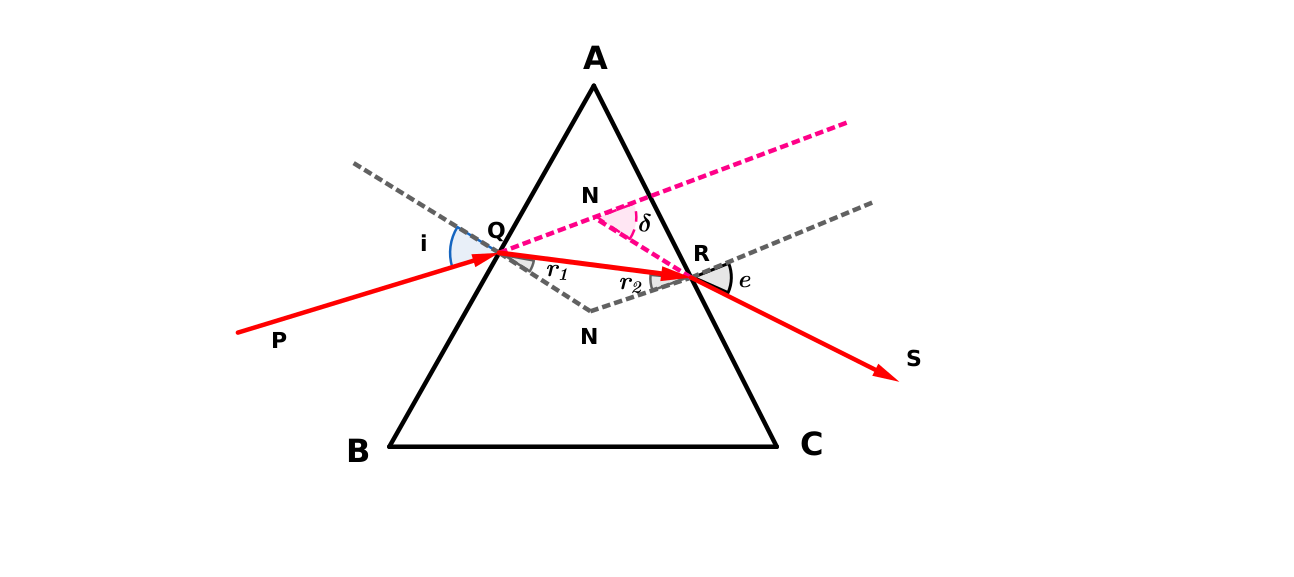
From quadrilateral AQNR$$\angle A+\angle\mathrm{AQN}+\angle\mathrm{ARN}+\angle{QNR}=360^{\circ}$$$$\angle A+90^{\circ}+ 90^{\circ}+\angle{QNR}=360^{\circ}$$$$\angle A +\angle{QNR}=180^{\circ}$$ From the trlangle QNR,$$r_{_1}+r_{_2}+\angle\mathrm{QNR}=180^{\circ}$$Compartng these two equattons, we get $$r_{_1}+r_{_2}=A\quad-----(1)$$The total deviation $\delta$ is the sum of devlattons at the two faces, $$\delta=(i-r_{_1})+(e-r_{_2})$$$$\therefore \delta=i+e-A\quad-----(2)$$When $\delta = D_{m}$, then $i= e$ and $r_{l}=r_{2}.$
from eq(1)and(2)
$2r=$A or $r=\frac{A}{2}$
$D_{\mathrm{m}}=2i-A$,or$i=(A+D_\mathrm{m})/2$
The refractive index of the prism is $$ \mu =\frac{\sin[(A + D_m)/2]}{\sin[A/2]}$$