Study Material
ELECTRIC CHANGES AND FIELDS
Short Answer Questions
Q1. Derive an expression for the intensity of the electric field at a point on the axial line of an electric dipole.
Answer
Ans. Let the point P be at distance $r$ from the centre of the dipole on the side of the charge $q$, as shown in figure.
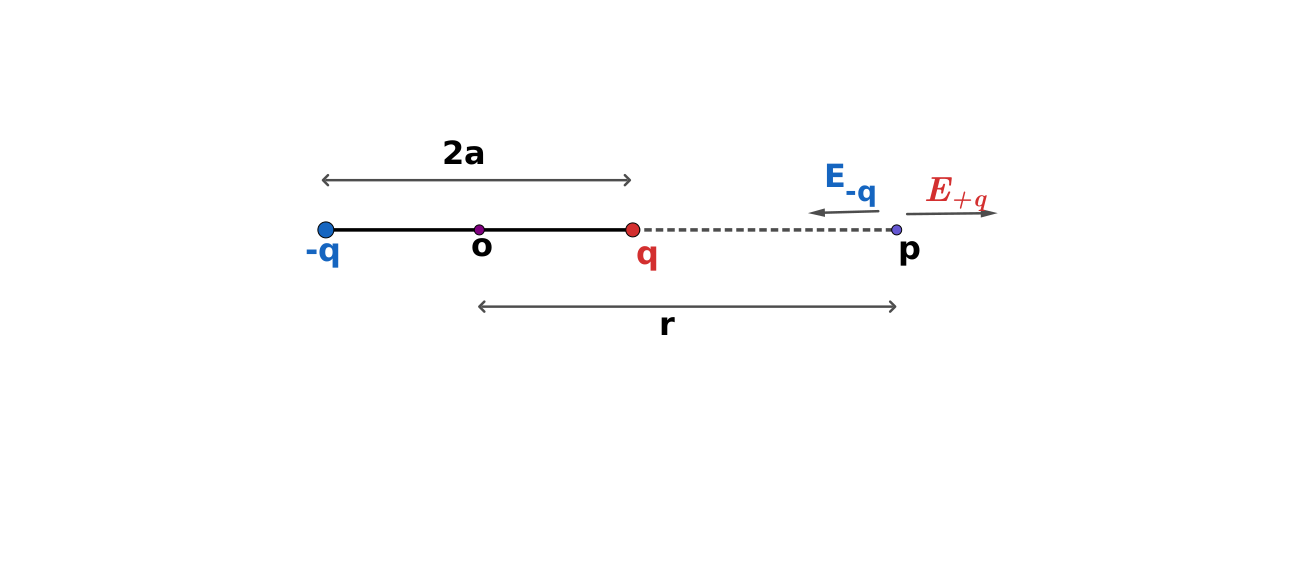 Then $$\mathbf{E}_{_{-q}}=-\: \frac{1}{4\pi\varepsilon_{0}} \frac{q}{(r+a)^{2}}$$$$\mathbf{E}_{+q}=\: \frac{1}{4\pi\varepsilon_{0}} \frac{q}{(r-a)^{2}} $$The total fleld at P is $$\mathbf{E}=\mathbf{E}_{+q}+\mathbf{E}_{-q}=\frac{q}{4\:\pi\:\varepsilon_{0}}\biggl[\frac{1}{(r-a)^{2}}\:-\:\frac{1}{(r+a)^{2}}\biggr]$$$$=\:\frac{q}{4\:\pi\:\varepsilon_{o}}\:\frac{4\:a\:r}{(\:r^{2}-a^{2})^{2}} $$For $r>>a$ $$\mathbf{E}=\frac{4\:q\:a}{4\pi\varepsilon_{0}r^{3}}$$$$\mathbf{E}=\frac{2P}{4\pi\varepsilon_{0} r^{3}}$$$$\text{Vector form}\:\: \mathbf{\vec{E}}=\frac{2P}{4\pi\varepsilon_{0} r^{3}}\hat{\mathbf{p}}$$