WAVES
Ans. Doppler effect: The apparent change in the frequency heard by an observer due to relative motion of source of sound and observer is known as Doppler effect.
Case (1) : Consider observer at rest and a source of sound $S$ moving with velocity ' $V_{s}$ away from an observer. Let the speed of sound in air $V$ , frequency $\nu_{_{\circ}}$ and time period $T_{_{\circ}}$ .As shown in the figure at the time $t=0$ source is at distance $L $ from the observer .
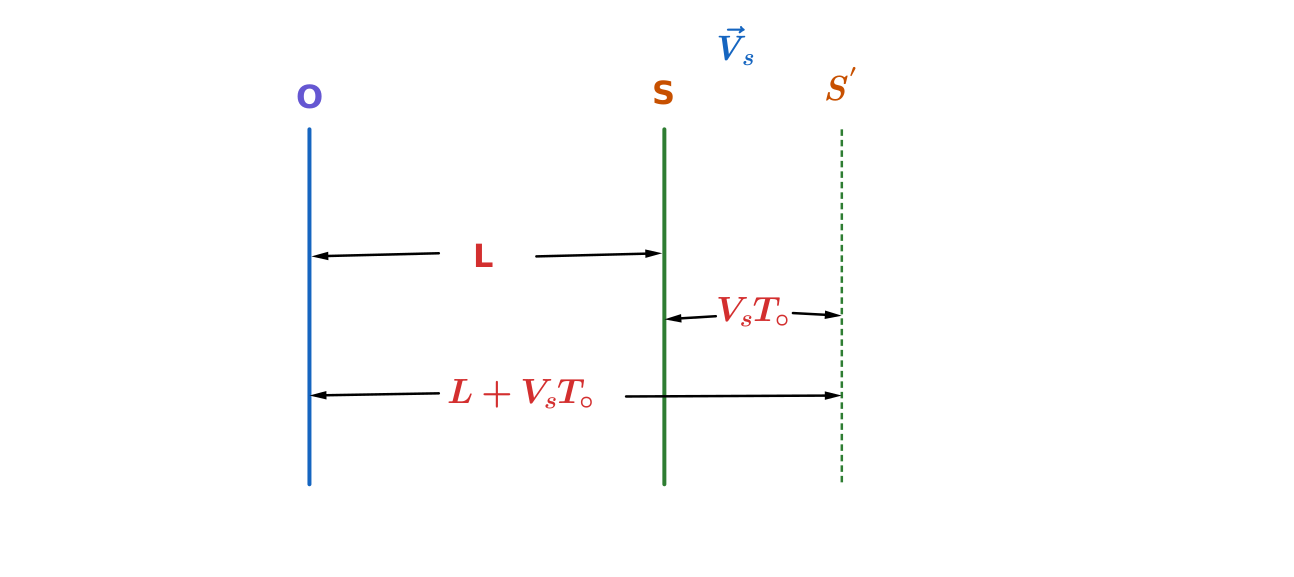 Therefore. At $t=0$ first crest reaches the observer at time $$t_{1}=\frac{L}{V}$$ $t=T_{o}$ second crest reaches the observer at time $$t_{2}=T_{ {\circ}}+\frac{L+V_{s}T_{o}}{V}$$ $t= nT_{o}$, $( \mathbf{n} + 1)$ crest reaches the observer at time $$t_{n+1}=nT_{\:o}+\frac{L+nV_{\:s}T_{\:o}}{\:V} $$
Time interval $$\begin{gathered}
\:t_{_{n+1}}-t_{_1}=\:nT_{_o}+\biggl(\frac{L+\:nV_{_s}T_{_o}}{V}\biggr )-\biggl(\frac{L}{V}\biggr ) \\
nT\:=\:nT_{_o}\left(1\:+\:\frac{V_{_s}}{V}\right) \\
T=T_{o}\left({1+\frac{V_{_s}}{V}}\right) \\
\mathrm{apparent\:\: frequency}\: \mathbf{\nu}={\frac{1}{T}}={\frac{1}{T_{o}\left({1+\frac{V_{_s}}{V}}\right)}} \\
\nu\:=\:\nu_{o}\biggl(1\:-\:\frac{V_{s}}{V}\biggr) \\
\end{gathered}$$
The above equation represents the apparent frequency while the source of sound is moving away from an observer.
Case (2): when source of sound is approaching the observer we replaced $V_{s}$ by $-\:V_{s}$ in the above equation
$\therefore$ apparent frequeny$$\nu^{\prime}\:=\:\nu_{o}\biggl(1\:+\:\frac{V_{s}}{V}\biggr)$$